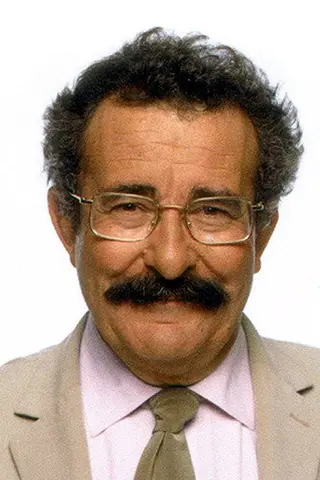
Robert Winston

Detalles
 Ep 1 1h 00m 20s
 Episodio 1
Builders in Miami, Florida unearth a ring of holes. The State then pays $27million to preserve either a Native American village or remnants of a 1950s sewerage system.
Horizon · S38E01
Ep 2 1h 00m 40s Episodio 2
A trail from Greenland to Britain via Latvia offers new evidence into how evolution could have seen aquatic life form legs and walk.
Horizon · S38E02
Ep 3 1h 00m 50s Episodio 3
A tropical seaweed that escaped from an aquarium is endangering sea life in the Mediterranean and has gone on to infect the California coast.
Horizon · S38E03
Ep 4 1h 00m 31s Episodio 4
Tim Lawrence was an all-action stuntman until hit by Parkinson's Disease. Horizon follows his hopes of a more normal lifestyle using Ecstasy - a class A illegal drug.
Horizon · S38E04
Ep 5 1h 00m 17s Episodio 5
The controversial theory that for millions of years the Earth was plunged into catastrophe - entirely smothered in ice up to one kilometre thick.
Horizon · S38E05
Ep 6 1h 00m 48s Episodio 6
Two disruptive children are followed through a controversial treatment regime.
Horizon · S38E06
Ep 7 1h 00m 14s Episodio 7
In November 2000, the international press reported an amazing find: a mummy, which was claimed to be that of an ancient Persian princess, over 2,600 years old. She was encased in a carved stone coffin, inside a wooden sarcophagus and was wearing an exquisite golden crown and mask. Her cloth-bound body was dressed with golden artefacts, with an inscription on her breastplate that read, "I am the daughter of the great King Xerxes, I am Rhodugune." All the internal organs had been taken out of her body, in the same way that the ancient Egyptians mummified their dead. It was the find of a lifetime, one of the most magnificent ancient treasures ever to be unearthed in the area. When the curator from the Karachi National Museum, Dr Asma Ibrahim, began her investigations into the mummy, a different story began to emerge. Horizon follows the story as forensic experts all over the globe analyse the mummy and her magnificent trappings and discover that she is an elaborate fake with a terrible secret. The mummy was found in a house in the desert region of Pakistan during a police raid, after a tip-off that it was to be illegally sold on the antiquities black market for $20m, and smuggled out of Pakistan. The Persian princess was immediately hailed as a major archaeological discovery. In fact, no Persian mummy had ever been found before, let alone a royal mummy. Mummification to preserve bodies had always been thought to be unique to the ancient Egyptians. However, there were some strange puzzles about this beautiful princess. The inscriptions on the mummy's breastplate had some grammatical errors. And there were peculiarities in the way she had been mummified. Several detailed operations common to Egyptian mummifications had been omitted. So it began to look like the mummy was not the princess she was supposed to be; perhaps she was a more ordinary ancient mummy dressed up to be a Persian princess by forgers trying to increase her value. As scientists investigated more closely, it became clear that this mummy had an even darker history. Computerised tomography (CT) scans and X-ray photographs of the body inside the mummy revealed that this was no ancient corpse but a woman who had died in the recent past, and that her neck was broken. An autopsy confirmed that this woman may indeed have been murdered to provide a body for the fakers to mummify - a body they intended to pass off as an ancient mummy for millions of dollars on the international art black market. And, finally there is evidence to suggest that they have done this not once but three times, raising the spectre of a mummy factory and the terrifying thought of yet more victims.
Horizon · S38E07
Ep 8 1h 00m 01s Episodio 8
In 2001, scientists announced an amazing discovery: the oldest skull of a human ancestor ever found. The 3 million year old fossil was remarkably complete, and unlike any previous fossil find. Its discovery - by a team led by Meave Leakey of the famous Leakey fossil-hunting family - has revolutionised our understanding of how humans evolved. The great mystery of our evolution is how an ape could have evolved into the extraordinary creature that is a human being. There has never been another animal like us on the planet. And yet ten million years ago there was no sign that humans would take over the world. Instead the Earth was dominated by the apes. More than 50 different species of ape roamed the world - ten million years ago Earth really was the planet of the apes. Three million years later, most had vanished. In their place came something clearly related to the apes, but also completely different: human beings! For years scientists searched for the first key characteristic which had allowed us to make the huge leap from ape to amazing human. At first they thought the development of our big brains was decisive. They even found the fossil that seemed to prove it, until along came the famous three million year old fossilised skeleton Lucy. This quashed the big brain theory, because here was a human ancestor which clearly walked on two legs, just as we do, but had the tiny brain of an ape. It seemed that the development of walking on two legs (bipedalism) was the first key human characteristic, the thing that set us on the road to becoming human. Lucy soon became even more important. She seemed to defy the laws of evolution. Normally a major evolutionary adaptation like walking on two legs is followed by what scientists call an adaptive radiation. Many related species quickly evolve from an initial evolutionary innovation. It gives a very bushy evolutionary family tree, with many different but related species. Scientists knew that the human branch of the family tree had begun about six or seven million years ago, when the planet of the apes ended. And yet there was no sign of an adaptive radiation. The family tree showed just a straight line leading from the planet of the apes through to Lucy. All that has changed with Meave Leakey's spectacular new discovery, named Kenyanthropus platyops or, less formally, Flat-faced Man. Her find is the same age as Lucy's species, but also completely different. It's proof that there were two different bipedal human ancestors living at the same time, more than three million years ago. And it's the first sign of the adaptive radiation that the theory of evolution says should have followed the planet of the apes.
Horizon · S38E08
Ep 9 1h 00m 10s Episodio 9
Matthew Farrow was born with a rare and fatal blood disease, Fanconi's anaemia. His family and doctors thought he was going to die. Instead, aged just five, he became the first person in the world to be given a radical new treatment that few believed would work. It saved his life. The treatment was remarkably simple. A small quantity of blood taken from a newborn baby's umbilical cord and placenta was infused into him. Thanks to this cord blood, Matthew Farrow is now a healthy teenager and the treatment he helped to pioneer is giving hope to hundreds of critically ill children around the world. Cord blood contains a large number of blood stem cells, the mysterious factory cells that make all the red and white blood cells our body needs. Stem cells can rebuild a sick child's blood system in just a few weeks, by producing healthy new blood cells. Until Matthew's case, babies' umbilical cords and placentas were just thrown away at birth. Established medical thought said the only source of blood stem cells was the bone marrow and the only treatment for children with advanced blood cancers was a bone marrow transplant. One in three affected children cannot find a suitable bone marrow donor, and there was a desperate need for an alternative. The first doctors to suggest cord blood as an answer were dismissed as dreamers. But pioneering work over the last twenty years, mainly in America, has shown that the tiny quantity of blood contained in a newborn's umbilical cord and placenta is rich in the crucial stem cells. It is now being used to help to treat a broad range of blood cancers and serious genetic blood diseases. However, even its advocates admit that cord blood is no miracle cure. Cord blood is a significant medical breakthrough, but it cannot save everyone who is treated with it. This powerful and moving film follows patients and their doctors as they go through this arduous new treatment. Not all patients survive the transplant. However, for some patients this treatment is a lifeline when there is no option of a bone marrow transplant. Since 1990, over a thousand lives have been saved by this new treatment.
Horizon · S38E09
Ep 10 1h 00m 59s Episodio 10
Out in deepest space lurks a force of almost unimaginable power. Explosions of extraordinary violence, are blasting through the Universe every day. If one ever struck our Solar System it would destroy our Sun and all the planets. For years no one could work out what was causing these awesome explosions. Now scientists think they have identified the culprit. It's the most extreme object ever found in the Universe; they have christened it a 'hypernova'.
Horizon · S38E10
Califica la serie
Compartir
AburridoEnElTrabajo
9 horas haceNostalgiaNoventera
2 días haceReinaDeDragones
3 días haceDefinitivamenteNoUnRobot
4 días haceCajaVacía
5 días hace99Botellas
6 días haceCapitánCalzoncillos
7 días haceFanDeHarryPotter4ever
8 días haceRobert Winston

La casa del dragón
Te encontraré

Rancho Dutton
FROM
Silo

The Bear

Avatar: La leyenda de Aang 2024

Elle

La maldición de Widow's Bay
Juego de tronos
Cape Fear

Vida, Larry David y la búsqueda de la infelicidad
La Agencia 2024
Breaking Bad
X-Men '97

The Boys
The Pitt
Rick y Morty

Spider-Noir

Yellowstone
Detalles